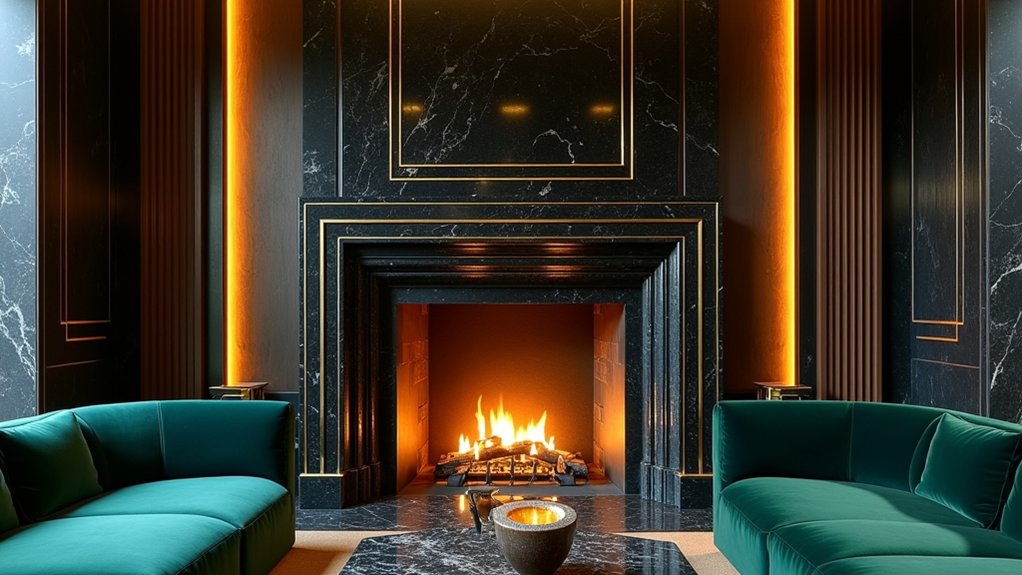
You can turn an Art Deco fireplace into a controlled architectural focal point by combining geometric form, durable materials, and carefully planned lighting. Start by choosing a fireplace type that suits your room, then confirm ventilation, clearances, and installation requirements. Its scale, finish, and position should support the surrounding layout rather than compete with it. The right mantel styling and modern heating technology can complete the effect, but several common design choices can undermine the result.
Key Takeaways
- Choose a fireplace with geometric profiles, stepped detailing, fluted surfaces, or polished metal accents to establish an Art Deco focal point.
- Position it on the room’s primary sightline and balance surrounding furniture to reinforce symmetry and architectural impact.
- Combine heat-resistant materials, bold stone patterns, restrained colours, and metallic trim for a luxurious yet cohesive composition.
- Integrate modern gas, electric, or wood-burning technology while preserving original Deco features and meeting safety requirements.
- Complete the feature with geometric lighting, sculptural mantel accessories, layered textures, and repeated metallic motifs.
Choose the Right Art Deco Fireplace Type
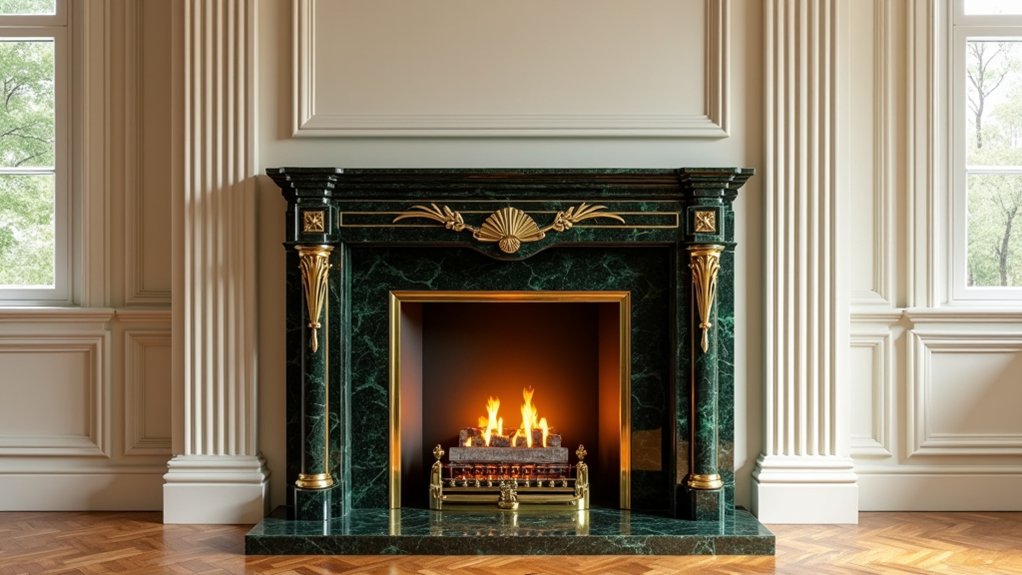
Start by choosing the fireplace type that fits your room’s layout, fuel access, and heating needs. A gas fireplace suits you if you want controllable flames, clean operation, and straightforward daily use. Select a wood-burning model when you value authentic fire, radiant heat, and access to seasoned fuel. An electric unit works well where you need flexible placement, adjustable heat, and no combustion.
Compare inserts, built-ins, and freestanding designs according to the visual weight and projection you want. Then match the surround to Art Deco motifs, such as stepped profiles, geometric inlays, fluted detailing, or polished metal accents.
Review Fireplace styles that balance the room’s proportions rather than overpowering them. Choose a mantel width, firebox shape, and finish that reinforce your focal point and coordinate with existing architectural lines.
Check Installation, Safety, and Room Requirements
Before installation, assess your floor, wall, and chimney structure to confirm they can support the fireplace.
Verify ventilation, flue routing, and required clearances, and don’t position combustible materials within restricted zones.
Follow local building, fire, and fuel-safety regulations, using a qualified installer where required.
Assess Structural Requirements
Assess the room and installation conditions before choosing an Art Deco fireplace. Begin with a foundation inspection to identify settlement, cracking, moisture damage, or weakened floor structures beneath the proposed location.
A qualified contractor should complete a load bearing assessment, especially when you’re installing a masonry surround, stone mantel, or substantial cast-iron insert. Confirm that joists, studs, and wall framing can support the finished assembly without deflection.
Check the substrate for levelness and verify that the hearth will sit on a stable, noncombustible base. Review local building requirements and obtain permits before construction begins.
If the room has historic fabric, document existing conditions and protect adjacent finishes during work. Ask a structural engineer to specify reinforcement where calculations show inadequate capacity, rather than relying on visual judgment alone.
Verify Ventilation and Clearances
Confirm that the fireplace has adequate ventilation and that every clearance meets the appliance manufacturer’s instructions and local code. Begin ventilation planning before installation, identifying required combustion-air openings, flue routes, and termination locations.
Don’t obstruct grilles, louvers, or air inlets with cabinetry, decorative panels, or the Art Deco surround. Measure the room and fireplace envelope, then apply the appliance’s clearance guidelines to walls, flooring, mantels, trim, furnishings, and combustible finishes.
Account for heat exposure above and beside the firebox, including projecting shelves or mirrors. Check that the proposed location leaves sufficient service access and permits the vent system to follow its specified length, diameter, and configuration.
Have the installer verify measurements on site, document them, and resolve conflicts before you close walls or order custom surround components.
Follow Safety Regulations
Follow the appliance manufacturer’s installation instructions, local building codes, and fire-safety regulations—not just the planned clearances. Confirm that your chimney, flue, hearth, and ventilation system meet current requirements before you operate the fireplace. Have a qualified professional inspect gas lines, electrical connections, dampers, and carbon-monoxide protection.
Install smoke and carbon-monoxide alarms at code-compliant locations, then test them regularly.
Check whether your room needs noncombustible flooring, wall protection, a raised hearth, or specified distances from furniture and curtains. Don’t assume an original Art Deco surround satisfies modern standards; historical authenticity must never override safety.
Obtain required permits and retain inspection records.
Schedule fireplace maintenance, including flue cleaning, seal inspection, and burner servicing, at the intervals recommended for your fuel type.
Stop using the appliance if you detect damage, unusual odors, smoke leakage, or poor draft.
Make Your Art Deco Fireplace the Focal Point
To make your Art Deco fireplace the focal point, position it on the room’s primary sightline and reinforce its geometry with balanced furniture placement. Keep surrounding surfaces visually quiet so the mantel, surround, and flame remain dominant.
Select a contrasting finish, such as polished stone against matte walls, to define the fireplace’s outline. Use Vintage motifs sparingly through stepped detailing, sunbursts, or geometric metalwork; each element should support, not compete with, the central feature.
Coordinate Color palettes by repeating one fireplace tone in nearby textiles or accessories, then limit additional accent colors. Install directional lighting above or beside the surround to emphasize relief and symmetry.
Maintain clear visual spacing around the hearth, and avoid clustering artwork or objects directly over the mantel. This controlled hierarchy makes the fireplace command attention without overwhelming the room.
Match the Fireplace to Your Room Layout

Assess your room’s proportions to choose a fireplace scale that won’t overwhelm the space. Position it to balance doors, windows, and key sightlines.
Then coordinate shelves, lighting, and furniture around its Art Deco surround.
Assess Room Proportions
Before choosing an Art Deco fireplace, measure the room’s wall height, width, and available depth so the surround suits the layout without overwhelming it. Compare the fireplace dimensions with the room size, allowing enough wall area for its geometric detailing to remain legible.
A tall surround can dominate a low ceiling, while a shallow model may look under-scaled against broad proportions. Check the firebox, mantel, and trim projections, then confirm they won’t restrict walkways or reduce usable floor space.
Assess furniture placement before selecting the width: sofas, chairs, and cabinets should retain practical clearance from the surround without making it appear isolated. Use a scaled floor plan or masking tape on the wall to test proportions.
Choose a fireplace that anchors the room visually while preserving comfortable circulation and functional space.
Position for Balance
Position the Art Deco fireplace where it reinforces the room’s main axis and complements existing furniture rather than competing with it. Center it on the longest wall when that wall faces the primary seating area.
In an open-plan room, align the fireplace with the principal circulation path or a defined seating zone, not an arbitrary architectural edge. Measure clearances from sofas, chairs, and walkways before fixing the location; you’ll preserve comfortable movement and maintain safe operating distances.
Use the room’s centerline to establish symmetry balance, but adjust slightly if a doorway, window, or structural feature makes exact centering impractical. Check the view from every major seat, ensuring the mantel remains visually stable.
This placement creates visual harmony by giving the fireplace authority without disrupting the room’s functional layout.
Coordinate Surrounding Features
Coordinate the mantel, hearth, and adjacent features with the room’s existing geometry and circulation. Align the fireplace centerline with a sofa, doorway, or principal sightline, then preserve clear walking routes around the hearth.
Keep furniture proportions compatible: low seating can emphasize the mantel, while tall Art deco furniture may require additional wall space and balanced vertical elements.
Repeat the fireplace’s materials in nearby surfaces to create continuity without making the room feel uniform.
Use geometric patterns selectively in rugs, upholstery, or lighting, matching their scale to the mantel’s detailing.
Position side tables, cabinets, and lamps symmetrically when the architecture supports it; otherwise, use visual weight to compensate.
Check door swings, radiator clearances, and code-required distances before installation.
You’ll create a cohesive focal point that supports daily movement and comfort.
Select Art Deco Materials and Finishes
Choose materials that express Art Deco’s geometric elegance while withstanding heat and daily use. For the surround, select noncombustible marble, granite, porcelain tile, or engineered stone rated for fireplace applications. Verify that the substrate, adhesive, grout, and sealant tolerate the manufacturer’s specified temperatures.
Polished marble reflects the symmetry associated with art deco architecture, while honed stone supplies a quieter, tactile finish. Use metal carefully: brass, chrome, or nickel can frame the opening, but keep combustible fixtures outside required clearances.
If you prefer vintage materials, inspect reclaimed stone and metal for cracks, corrosion, lead coatings, or heat damage before installation. Seal porous surfaces to resist soot, then choose a finish that you can clean without abrasion.
Coordinate sheen and texture with adjacent furnishings, not colour, to preserve a refined, durable composition.
Choose Geometric Colours for Deco Impact
Let the fireplace’s geometry guide a restrained colour scheme: pair one deep field colour, such as charcoal, navy, forest green, or oxblood, with a lighter stone or plaster tone and a controlled metallic accent. This three-part structure gives your surround visual hierarchy without overwhelming the room.
Use the light tone on broad planes or adjacent walls to reflect light and clarify stepped profiles. Reserve brass, bronze, or chrome for narrow inlays, trim, or a frame; too much metal weakens the architectural focus.
When selecting Colour palettes, sample each finish beside the fireplace under daylight and evening lighting.
Build Pattern contrasts through scale rather than random variety: combine large solid fields with fine lines, fan motifs, or chevrons. Keep undertones consistent, and repeat one accent colour in nearby furnishings for cohesion.
Add Modern Heating Without Losing Deco Style

If you’re upgrading the heat source, select a modern electric, gas, or wood-burning insert that fits the fireplace opening without obscuring its geometric surround. Measure the opening, verify clearance requirements, and confirm that the chosen unit meets local installation codes.
Electric models simplify installation and provide controllable heat without a flue.
Gas inserts deliver efficient warmth but require certified connections, ventilation, and carbon-monoxide protection.
Wood-burning units create authentic Vintage charm, yet they demand a compliant chimney, hearth protection, and regular maintenance.
Use Modern technology, such as programmable thermostats, remote controls, or thermostatic modulation, to regulate temperature efficiently.
Keep the original mantel, tiles, and metalwork intact where possible; these details preserve Deco character.
Before installation, have a qualified technician inspect the structure and commission the appliance safely.
Frame the Fireplace With Deco Lighting
Frame the fireplace with Deco lighting that emphasizes its symmetry, stepped geometry, and reflective materials without competing with the firebox. Choose matching wall sconces, then mount them at eye level or slightly above the mantel line to create visual balance.
Select fixtures with geometric shades, polished metal, or frosted glass, and keep their profiles proportional to the surround. For practical lighting design, install dimmers so you can shift from bright task illumination to a softer evening glow.
Aim each fixture toward the wall or surround rather than directly into the room, reducing glare on glossy tile and metal.
Coordinate color schemes carefully: warm white lamps complement brass, bronze, cream, and walnut, while cooler light suits chrome, black lacquer, and gray stone.
Conceal wiring to preserve clean Deco lines.
Style the Mantel With Deco Objects
Style the mantel with geometric accents, such as stepped vases, angular sculptures, or sunburst forms, to reinforce the fireplace’s Art Deco structure.
Layer metallic accessories in brass, chrome, or bronze, but vary their heights and finishes for controlled contrast.
Keep the arrangement balanced and leave enough surface space to preserve visual clarity.
Choose Geometric Accents
Choose geometric accents that echo Art Deco’s defining lines—stepped forms, arches, fans, chevrons, and sunbursts—then arrange them in a controlled mantel composition.
Select objects with varied heights, but keep their visual weight balanced from end to end. Place the tallest piece slightly off center, then use smaller forms to create asymmetrical symmetry without clutter.
Repeat two or three geometric patterns across framed art, ceramics, or sculptural objects so the arrangement feels intentional.
Limit your color schemes to a dominant neutral plus one or two saturated Deco tones, such as emerald, navy, or burgundy.
Maintain consistent spacing between objects, and leave visible wall or mantel surface around each piece.
Avoid mixing too many motifs; a restrained selection will sharpen the fireplace’s architectural impact and preserve a cohesive focal point.
Layer Metallic Accessories
Layer brass, chrome, or bronze accessories into the mantel arrangement to introduce the polished contrast associated with Art Deco design. Select one dominant finish and repeat it across two or three objects for cohesion.
Balance a streamlined clock, faceted vase, sculptural figurine, or mirrored tray against the fireplace’s geometric structure. Keep metallic accents proportional to the mantel; oversized pieces can obscure the surround, while tiny objects may lose visual impact.
Use varied heights to create a stepped composition, then leave deliberate gaps so each item remains distinct. Echo an Art Deco pattern through sunburst details, chevrons, fan shapes, or stepped edges rather than mixing unrelated motifs.
Position reflective pieces where they’ll catch firelight without producing glare. Finally, view the arrangement from the room’s main approach and adjust spacing until the display feels symmetrical, controlled, and refined.
Avoid These Art Deco Fireplace Mistakes
Avoiding common design mistakes keeps an Art Deco fireplace from looking dated or theatrical. Start by limiting competing geometric patterns. If your Art Deco furniture already features strong curves, fluting, or stepped forms, choose a quieter rug and wall finish.
Don’t combine several metallic finishes without repetition; select one dominant tone, then balance it with a compatible accent. Avoid oversized accessories that obscure the mantel’s symmetry or reduce safe clearance around the firebox.
Treat vintage décor selectively rather than arranging a crowded collection. Check scale carefully: a narrow mantel needs restrained objects, while a broad surround can support a larger focal piece.
Don’t ignore materials and maintenance. Use heat-resistant finishes, protect delicate surfaces, and follow the appliance manufacturer’s clearance requirements.
Finally, keep lighting layered, because harsh overhead illumination can flatten the fireplace’s relief and diminish its architectural impact.
Frequently Asked Questions
How Much Does an Art Deco Fireplace Typically Cost?
You’ll typically pay £1,500–£10,000 for an Art Deco fireplace, depending on condition, materials, and provenance. Cost considerations include restoration and installation; design options, such as reproduction or authentic antiques, substantially affect your final budget.
Can an Art Deco Fireplace Increase My Home’s Resale Value?
Yes, an Art Deco fireplace can increase your home’s resale value when buyers appreciate its Historical significance and craftsmanship. You’ll maximize returns through professional restoration, code compliance, and cohesive Interior design that complements the property’s architecture.
Where Can I Find Authentic Vintage Art Deco Fireplaces?
You can find authentic vintage Art Deco fireplaces through architectural salvage dealers, specialist auctions, antique showrooms, and estate sales. Verify provenance, materials, dimensions, restoration records, vintage craftsmanship, and design authenticity before purchasing or arranging installation.
How Do I Maintain and Clean an Art Deco Fireplace?
You’ll preserve its timeless lines by using gentle Cleaning techniques: vacuum dust, wipe surfaces with pH-neutral soap, and avoid abrasives. Follow Maintenance tips: inspect flues, remove rust, and schedule professional servicing annually.
Can an Art Deco Fireplace Be Installed in a Listed Building?
Yes, you can install an Art Deco fireplace in a listed building, but you’ll need listed-building consent, comply with Building regulations, and consult conservation officers to protect original fabric and meet Historical preservation requirements.
Conclusion
An Art Deco fireplace can anchor a room when you balance geometry, scale, safety, and performance. Select durable materials, verify ventilation and clearances, then coordinate the surround, lighting, furniture, and mantel objects as one composition. Use layered illumination to emphasize reflective finishes without creating glare. For visual proportion, remember the 60-30-10 rule: 60% dominant color, 30% secondary tone, and 10% accent. With disciplined planning, you’ll create a bold feature that’s elegant, functional, and structurally appropriate.